
Panel Schedule Drafting Standards: What Actually Makes One Build-Ready
Most panel schedules pass a visual check and still fail in the field. Here's what actually makes one build-ready.
Pathworks Engineering Team
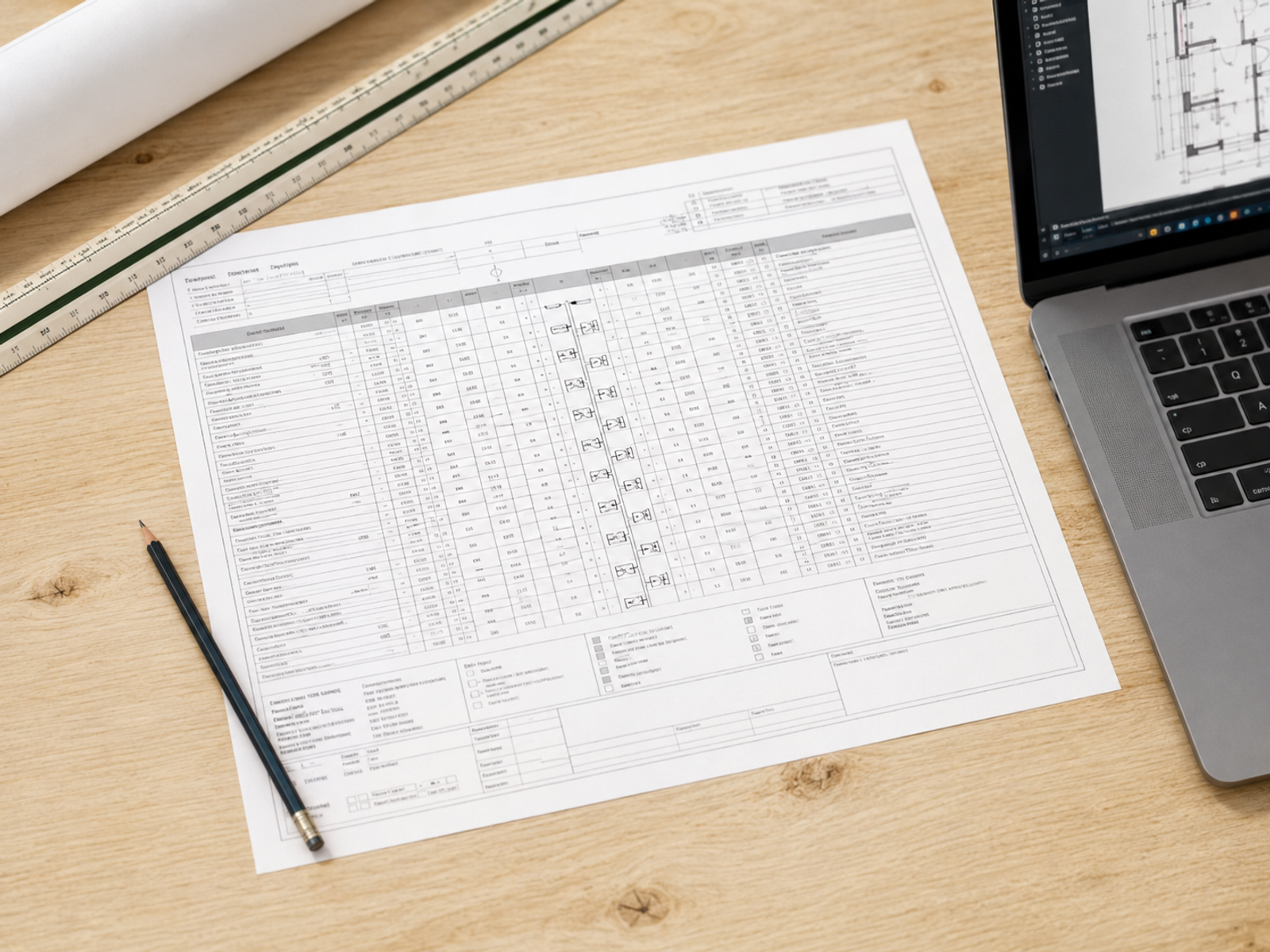
A panel schedule that is technically correct and a panel schedule that is genuinely build-ready are not automatically the same document, and the gap between them is one we encounter constantly in redrafting work sent to us by clients. A schedule with accurate breaker sizes, correct circuit descriptions, and a technically sound underlying load calculation can still generate a stream of RFIs once it reaches the field, simply because it was not drafted against the specific conventions that an installing electrician, a commissioning technician, and a plan reviewer actually need in order to use the document without having to interpret or guess at the designer's intent.
This article walks through the specific drafting gaps that most commonly generate field RFIs and change orders, why these are fundamentally drafting discipline issues distinct from the underlying engineering, and what a panel schedule needs to include to actually function as a build-ready deliverable rather than merely a technically accurate one.
The Specific Gaps That Generate Field RFIs
Ambiguous or inconsistent circuit descriptions. A circuit description that simply reads "Receptacles," repeated identically across fourteen separate circuits on the same schedule with no room number, area name, or other locating reference, forces an electrician troubleshooting a dead outlet to physically trace wiring back to the panel in order to identify which of those fourteen circuits they are actually working with. A build-ready schedule ties every circuit description to a specific, drawing-referenced location: "Receptacles, Room 214, North Wall" rather than a generic load-type label that could apply equally to any of a dozen circuits on the same panel.
Missing or inconsistent phase balancing documentation. A well-drafted panel schedule should make phase loading visible to a reviewer at a glance (showing connected load broken out per phase, not merely per individual circuit) so that an inspector or a commissioning electrician can verify balanced loading across all three phases without having to perform the summation arithmetic themselves from a column of individual circuit values. A schedule that omits this phase-level rollup is technically complete in the sense that all the underlying data is present, but it is not actually usable without additional work that the schedule itself should have already done.
Breaker and conductor sizing shown without visible calculation basis. A schedule that simply lists a 20-amp breaker on a given circuit, with no visible connected load value or demand factor applied, forces a plan reviewer to either trust the sizing on faith or issue a formal RFI requesting backup calculations: and both of those outcomes slow the project down, one by introducing unquantified risk and the other by adding a review cycle that a more complete schedule would have avoided entirely. Showing the connected load, the demand factor applied, and the resulting ampacity directly on or immediately adjacent to the schedule closes this gap before a reviewer ever has to ask the question.
Spare and space capacity documented without reference to intended future load. A notation of "20% spare capacity" written without any reference to what that spare capacity is actually reserved for, or whether it reflects genuine physical space versus merely unused breaker positions, is functionally close to meaningless to a future engineer evaluating whether the panel can support a planned addition years later. It is also one of the most common reasons an otherwise well-executed panel schedule ends up requiring a complete re-study five or ten years later, rather than a straightforward capacity check against a documented reserve, simply because nobody recorded what the spare capacity was originally intended to accommodate.
Notation that fails to match the referenced one-line diagram exactly. Panel naming conventions, feeder tags, and breaker numbering shown on the panel schedule have to match the facility's one-line diagram and the physical labeling installed in the field precisely and without exception. A single naming mismatch between the schedule and the one-line (even something as apparently minor as "PP-1" on one document and "PP1" on the other) is a small drafting inconsistency on paper that becomes a genuinely significant field problem the first time someone is trying to trace a circuit correctly and quickly during an active outage, when the cost of confusion is measured in downtime rather than mere annoyance.
Why This Is a Drafting Discipline, Not Purely an Engineering One
The underlying engineering behind a panel schedule (the load calculation methodology, the demand factor selection, the breaker sizing performed in accordance with NEC Article 240) is necessary, but it is not sufficient on its own to produce a usable deliverable. The resulting document has to be legible and unambiguous to at least three distinct downstream users, each of whom has a different relationship to the document and a different set of needs from it: the installing electrician, who needs to physically land conductors correctly on the first attempt without needing to call the design office for clarification; the authority-having-jurisdiction plan reviewer, who needs to verify code compliance efficiently without requesting a phone call or a formal RFI to resolve an ambiguity that better drafting would have prevented; and the future engineer, who will use this exact schedule as the baseline reference for the next capacity study or renovation project that touches this electrical system, potentially years after the original design team has moved on to other work.
A schedule drafted with only the first of these three audiences in mind (essentially, drafted to satisfy an immediate construction need) frequently fails the second and third audiences in ways that only become apparent much later, when a plan reviewer bounces the submittal or a future engineer inherits a document that technically contains the right numbers but doesn't communicate the underlying assumptions clearly enough to be trusted without independent verification.
Formatting Conventions That Consistently Reduce Field Confusion
Beyond the specific content gaps described above, several formatting conventions consistently reduce ambiguity and field confusion across the panel schedules we review and redraft. Consistent circuit numbering conventions that match standard panel bus arrangement (typically odd numbers on one side and even numbers on the other, following the panel manufacturer's actual physical layout rather than a purely sequential numbering scheme that doesn't correspond to anything a technician sees when the panel door is open) reduce the chance of miswiring during installation. Clear visual separation between three-phase, two-pole, and single-pole circuits, rather than relying solely on a numeric breaker size to communicate pole count, helps a reviewer catch pole-count errors at a glance rather than requiring careful reading of every row. And explicit documentation of any circuits serving life-safety or emergency systems, called out distinctly from standard circuits rather than blended into the general schedule, both satisfies code documentation requirements and makes the schedule immediately more useful to anyone responding to an emergency system fault under time pressure.
Why This Connects Directly to the Underlying Load Study
This drafting-quality discussion connects directly to why a load flow study, covered in more depth in our companion post on why nameplate kVA isn't demand, only delivers its full engineering value to a client once its outputs are drafted into a panel schedule format that the next party in the process (an electrician, an inspector, a future engineer) can act on directly, without needing to translate or reinterpret the underlying analysis themselves. An excellent load flow study paired with a poorly drafted panel schedule still produces field confusion and RFIs, because the field never actually sees the quality of the underlying engineering: it only sees the document that was handed to it.
How We Approach This
Redrafting a client's existing panel schedules against a single, internally consistent standard (closing exactly the gaps described above) is one of the most common requests we receive at Pathworks, and it frequently arrives alongside a broader as-built reconciliation effort where the schedules need to be brought into alignment with both the current one-line diagram and actual field conditions simultaneously. We treat panel schedule drafting as a discipline in its own right, distinct from though obviously dependent on the underlying load calculation, because we have seen directly how much field friction a well-drafted schedule eliminates compared with one that is merely technically accurate. See our Electrical Engineering Services page for more on how we scope this work.
Conclusion
A panel schedule's job is not simply to record correct numbers (it is to communicate those numbers unambiguously to three different audiences with three different needs, none of whom should have to guess at the designer's intent or place a phone call to resolve an avoidable ambiguity. The specific gaps described in this article) vague circuit descriptions, missing phase balance documentation, sizing shown without calculation basis, undocumented spare capacity, and naming inconsistencies against the one-line diagram: are individually minor drafting choices, but collectively they determine whether a schedule functions as a genuinely useful field and planning document or merely as a technically accurate record that still requires interpretation every time someone actually needs to use it.
References
- NFPA 70 (National Electrical Code), Article 408: Switchboards, Switchgear, and Panelboards
- NECA 400: Recommended Practice for Installing and Maintaining Switchboards
- Related reading: Load Flow Studies for Industrial Facilities: Why Nameplate kVA Isn't Demand
- Related reading: Reading a Single-Line Diagram: A Field Engineer's Quick Reference
- Pathworks services: Electrical Engineering Services
Related articles


Load Flow Studies for Industrial Facilities: Why Nameplate kVA Isn't Demand
Nameplate kVA tells you almost nothing about actual demand. Here's why a load flow study built on real data changes the answer.

Short-Circuit Studies: What the Per-Unit Method Is Actually Calculating
The per-unit method isn't a shortcut, it's the actual math behind every short-circuit study. Understanding what it's calculating changes how you read the results.
Arc-Flash Studies Explained: What They Are and When You Need One
Arc-flash studies get requested reactively, usually after an incident or an audit finding. Here's what the study actually calculates and why waiting for a trigger event is the expensive way to find out you need one.