
Greenfield FTTH design for 500 homes, full OSP package from plat to BOM
A private greenfield builder bringing GPON fiber to a new 500-home suburban subdivision, designed to the same OSP pattern Pathworks uses for subcontracted packages under BEAD/RDOF-funded rural cooperatives.
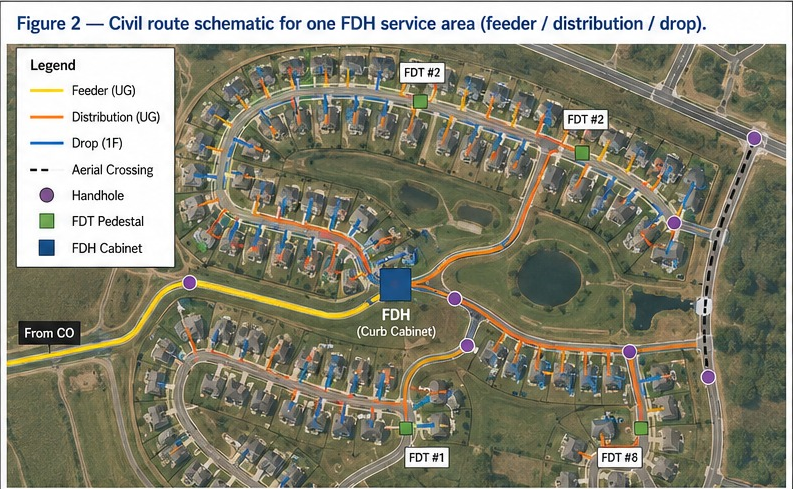
- Input received
- The subdivision plat with lot layout and home count (~4 homes/acre), the target GPON architecture, and local joint-trench and AHJ burial requirements.
- Delivered
- A complete outside-plant design: two-stage centralized/distributed GPON topology (FDH/FDT), civil route and handhole plan, fiber count and splice architecture by tier, a cumulative optical link budget, and a procurement-ready bill of materials.
- Timeline
- Scoped in 2 hours, delivered in 2 business days.
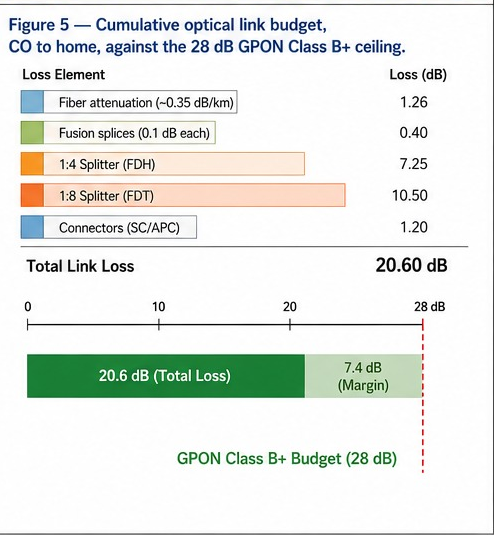
Built to standard US ILEC/CLEC practice: a two-stage 1:4/1:8 split localizes fault response to a single FDT instead of the whole feeder, construction runs underground-first to meet HOA aesthetic requirements, and 20–30% spare fiber is held at every tier so the network can absorb infill lots without a re-trench. The design closes with 7.4 dB of optical margin against the 28 dB GPON Class B+ budget, enough headroom for a future 1:64 upgrade at a subset of FDTs.
- Homes passed
- 500
- Effective split
- 1:32
- Link margin
- 7.4 dB
- Feeder route
- 1.8 mi
1. Project overview
| Parameter | Detail |
|---|---|
| Location type | Greenfield suburban subdivision, single-family homes |
| Homes passed | 500 |
| Lot density | ~4 homes/acre, avg. 60 ft frontage |
| Technology | GPON (ITU-T G.984), 2.488G down / 1.244G up per PON port |
| Construction method | 90% underground joint trench, 10% aerial road crossings |
| Standards | TIA-568/598, Telcordia GR, NESC (aerial) |
This mirrors the design pattern used for a subcontracted OSP package under a BEAD/RDOF-funded rural cooperative or a private greenfield builder contract. The greenfield case is used here to isolate the pure design mechanics without funding-program scoring noise.
2. Network architecture
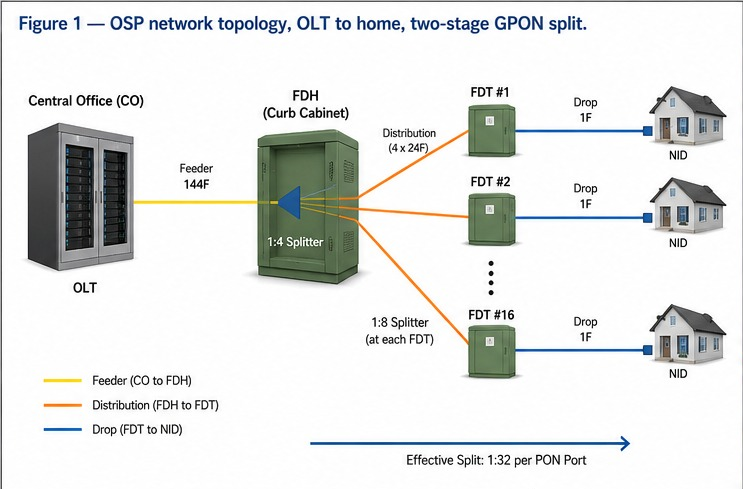
Topology: centralized split, two-stage PON, 1:4 at the Fiber Distribution Hub (FDH), 1:8 at each Fiber Distribution Terminal (FDT), giving an effective 1:32 split per PON port. This is the standard US ILEC/CLEC design pattern, chosen because it localizes fault isolation to one FDT (1/16th of the subdivision) instead of the whole feeder.
3. Civil route design
Feeder and distribution runs underground in joint trench with power/gas at subdivision build stage; two arterial road crossings run aerial on strand-lashed ADSS at NESC Grade C clearance. Handholes are placed at every FDT for splice access without a full re-trench.
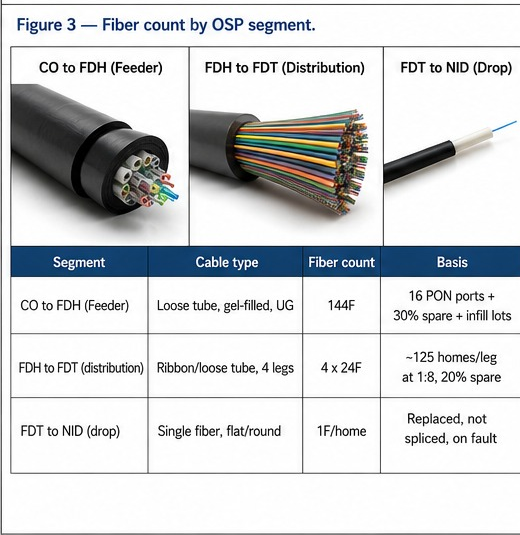
4. Fiber count planning
| Segment | Cable type | Fiber count | Basis |
|---|---|---|---|
| CO to FDH (feeder) | Loose tube, gel-filled, UG | 144F | 16 PON ports + 30% spare + infill lots |
| FDH to FDT (distribution) | Ribbon/loose tube, 4 legs | 4 x 24F | ~125 homes/leg at 1:8, 20% spare |
| FDT to NID (drop) | Single fiber, flat/round | 1F/home | Replaced, not spliced, on fault |
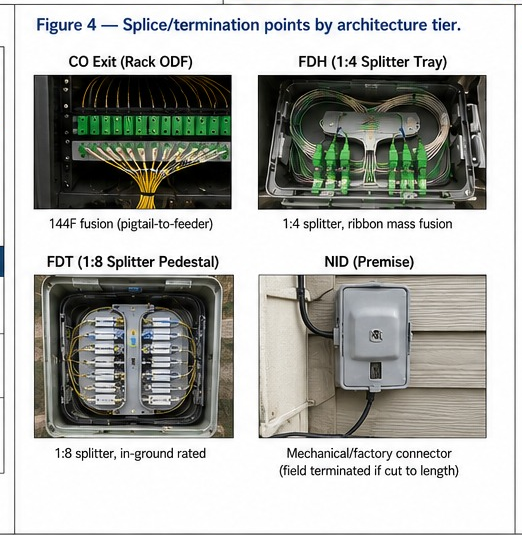
5. Splice architecture
| Location | Closure type | Splice count | Notes |
|---|---|---|---|
| CO exit | Rack-mount ODF, 144F | 144 fusion | Pigtail-to-feeder |
| FDH (curb cabinet) | 1:4 splitter, in-cabinet tray | 4 splitters + 144F through | Ribbon mass fusion preferred |
| FDT (pedestal) | 1:8 splitter | 8 splitters x 16 FDTs | In-ground rated |
| NID (premise) | Mechanical/factory connector | 0 | Field-terminated only if cut to length |
Splice loss budget: 0.1 dB per fusion splice, consistent with Telcordia GR-326 fusion performance criteria.
6. Optical link budget
GPON Class B+ OLT/ONT optics: 28 dB budget (1490 nm downstream).
| Loss element | Value | Quantity | Total loss |
|---|---|---|---|
| Fiber attenuation (~0.35 dB/km) | 0.35 dB/km | 3.6 km | 1.26 dB |
| Fusion splices | 0.1 dB each | 4 | 0.40 dB |
| 1:4 splitter (FDH) | 7.25 dB (PLC) | 1 | 7.25 dB |
| 1:8 splitter (FDT) | 10.5 dB (PLC) | 1 | 10.5 dB |
| Connectors (SC/APC) | 0.3 dB each | 4 | 1.2 dB |
Total link loss ≈ 20.6 dB against a 28 dB budget, leaving 7.4 dB of margin, enough to absorb aging, additional splice restoration, and a future 1:64 upgrade at a subset of FDTs without redesigning the feeder.
7. Bill of materials (summary)
| Item | Spec | Qty |
|---|---|---|
| Feeder cable | 144F loose tube, gel-filled, armored, UG | 1.8 mi |
| Distribution cable | 24F ribbon, UG rated | 1.2 mi (4 legs) |
| Drop cable | 1F flat, self-supporting where aerial | 500 units, avg 150 ft |
| FDH cabinet | 288F capacity, 1:4 splitter bank | 1 |
| FDT pedestal | 1:8 splitter, 24-port | 16 |
| NID | Single-port, weatherproof, SC/APC | 500 |
| Handholes | 17x30 in, polymer concrete | 18 |
| HDPE conduit, 2 in | SDR-11 | 1.8 mi |
8. Key design decisions & rationale
1:32 over 1:64 split: protects optical margin given feeder distance; avoids forcing a high-power OLT card purchase.
Centralized FDH / distributed FDT (two-stage): matches US ILEC standard practice; localizes fault response to one FDT rather than the whole feeder.
20–30% spare fiber at every tier: same discipline as passive ODN designs elsewhere; the US-specific addition is joint-trench coordination with power/gas utilities and deeper AHJ-mandated burial depths.
Underground-first: driven primarily by HOA/municipal aesthetic requirements in US greenfield subdivisions, with long-term reliability as a secondary benefit.
This case study is a representative composite built to standard US FTTH engineering practice (TIA/Telcordia/NESC-compliant, GPON Class B+ optics) rather than a specific carrier's confidential project file: the architecture, split ratios, and budget math are the ones applied to a real BEAD subgrantee LLD package.
More case studies
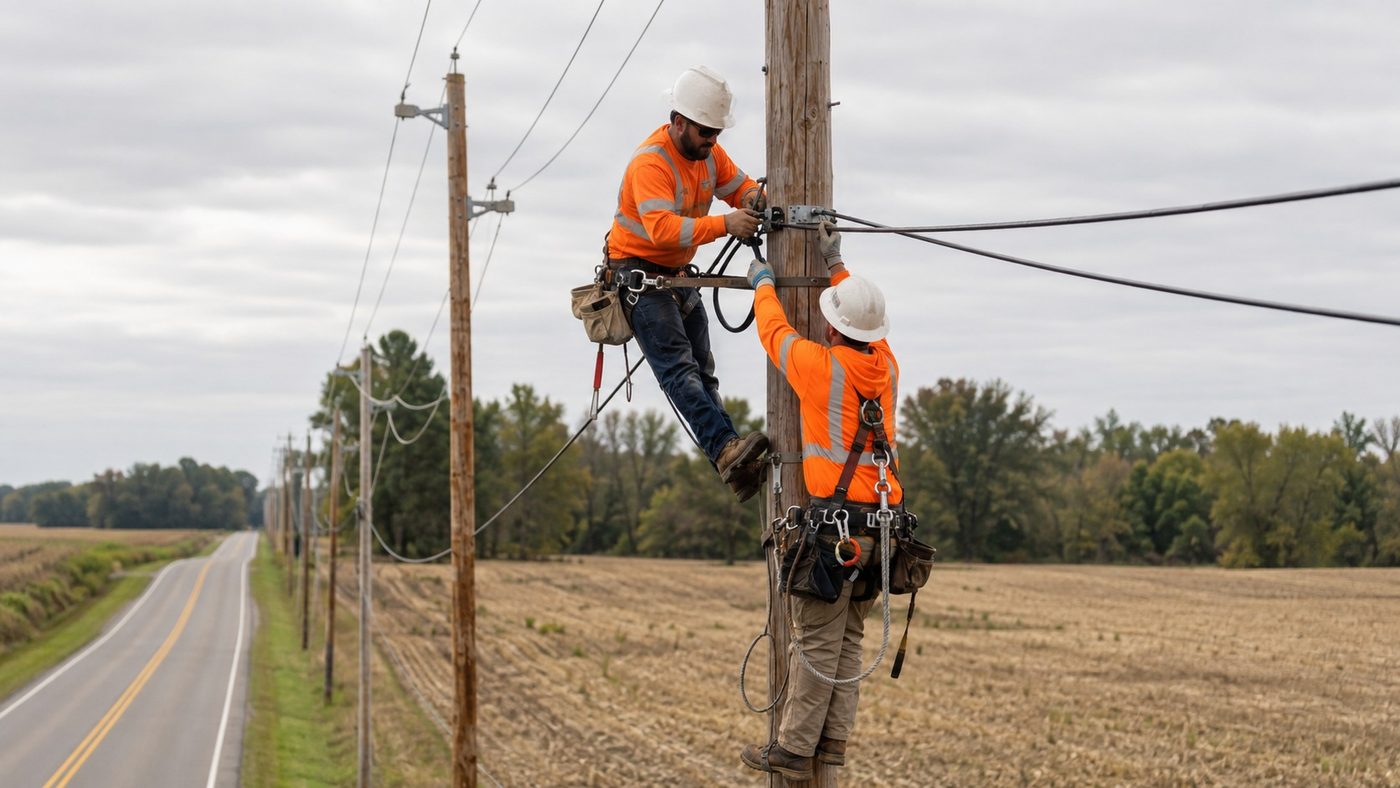

Rural greenfield FTTH design for a 500-location BEAD service area
A two-stage 1:32 split architecture assigns all 500 approved locations to complete XGS-PON paths across 512 terminal ports. Route optimization reduces the seed alignment from 35.7 to 33.0 miles, a 7.6% reduction, while the modeled planning cost falls from $9,460 to $8,940 per passing and the worst modeled path retains 4.74 dB of N2 optical margin.
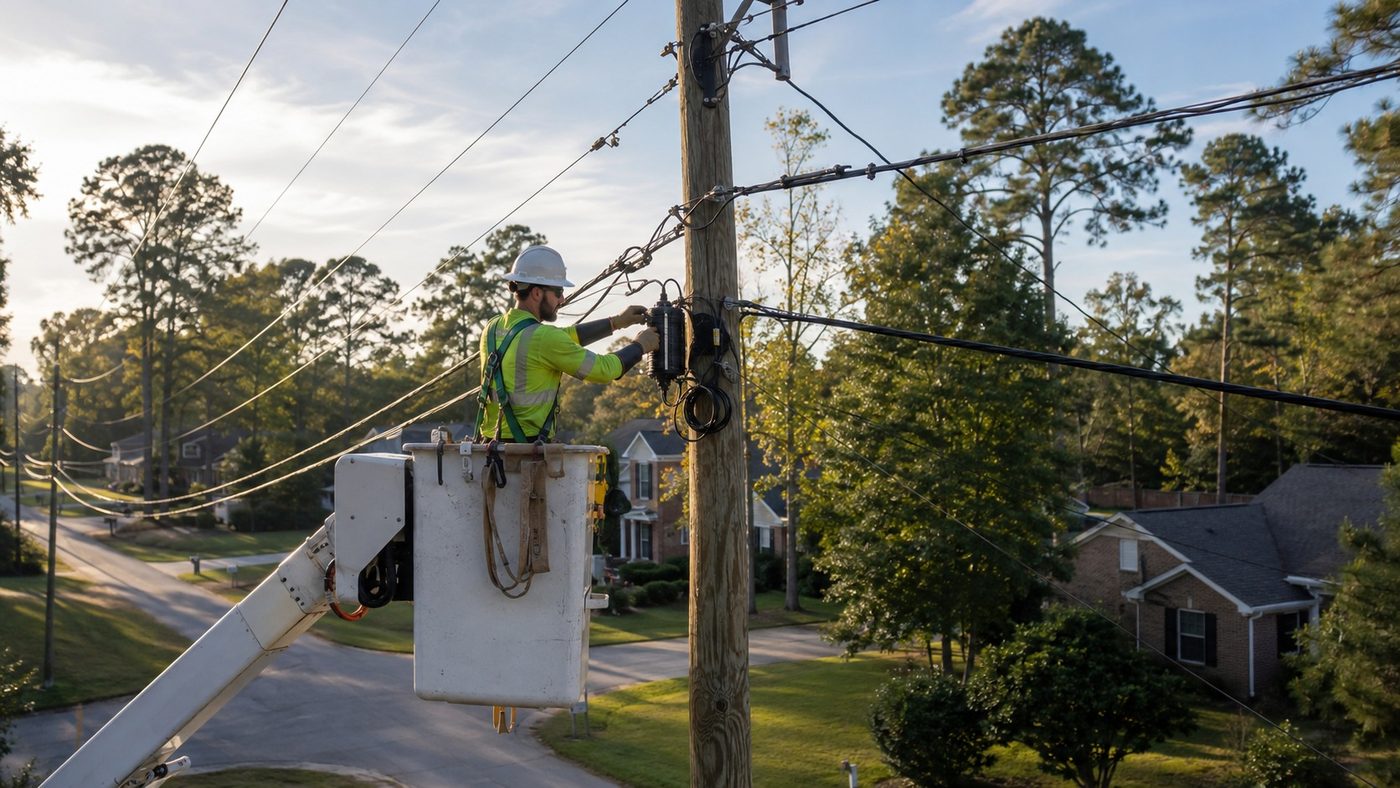
Aerial FTTH design and pole make-ready analysis
A pole-by-pole evidence record separates clean attachment candidates from conditions that require transfer, rearrangement, guying review or replacement. The modeled review identifies 226 make-ready or data conflicts across 1,946 poles; design adjustments resolve 141 before application packaging, including 15 avoided pole-replacement candidates, reaching 92% first-submission readiness.
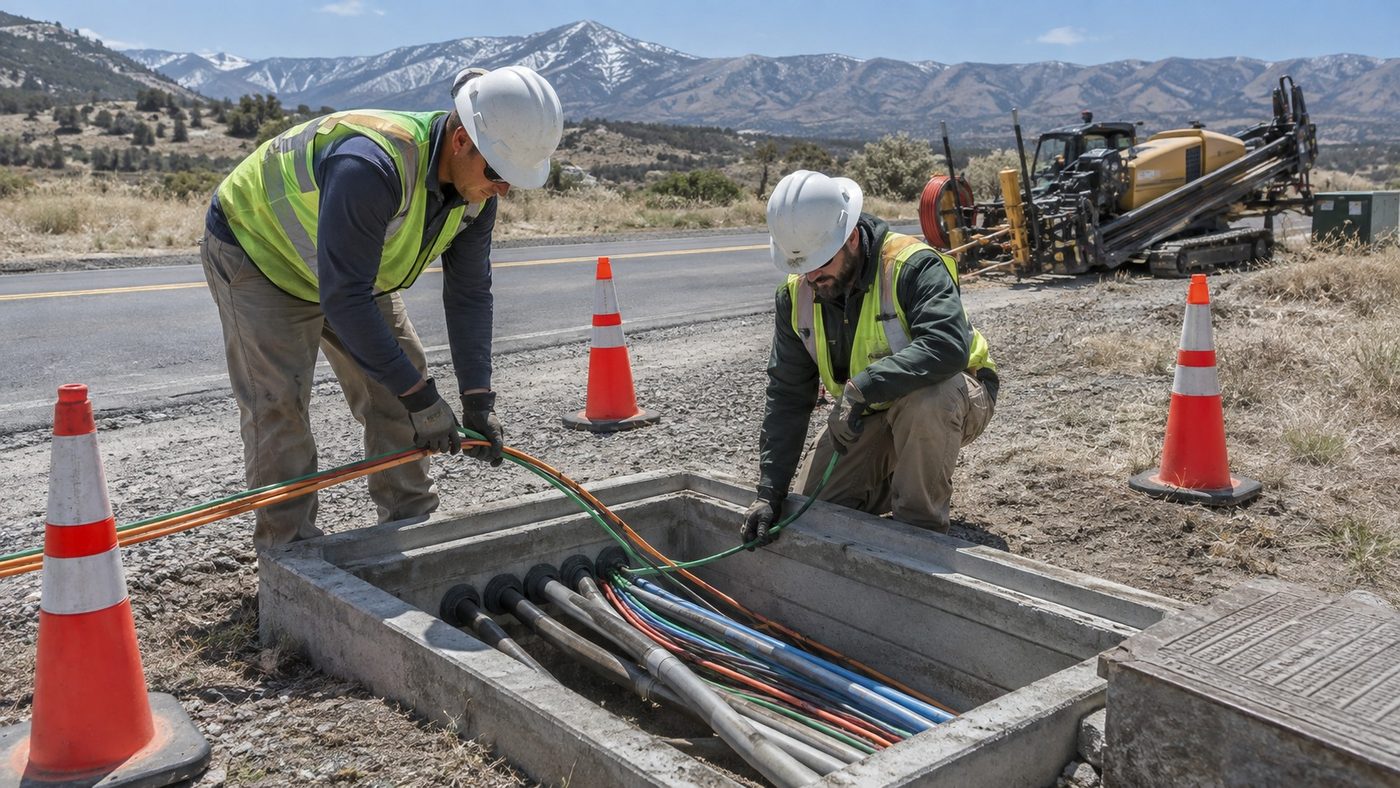
Underground FTTH and right-of-way permit design
One connected network model is divided into nine jurisdiction-specific permit packages. The modeled design resolves 51 of 64 identified utility conflicts before permit issue, shortens the initial route by 1.9 miles, and the revised quantities indicate approximately $410,000 in avoided construction and restoration cost relative to the seed alignment.