
Reading a Single-Line Diagram: A Field Engineer's Quick Reference
Single-line diagrams pack an entire electrical system into one page of symbols. If you're not fluent in the notation, here's a working reference you can actually use on site.
Pathworks Engineering Team

A single-line diagram (SLD) represents a three-phase system with one line instead of three, which makes it compact but also means every symbol is doing real work. Misreading one symbol can mean misreading the whole system. This is a working reference, not an exhaustive standard.
Start at the source and follow the flow
Every SLD reads left-to-right or top-to-bottom from the source (utility feed, generator, or both) down through protection devices to the loads. Before decoding individual symbols, trace this backbone. It tells you what feeds what before you worry about ratings.
Protection devices are not interchangeable symbols
A breaker, a fused disconnect, and a relay-protected breaker with a specific protection function look similar at a glance but mean very different things for coordination and fault response. Check the symbol legend on every drawing set: conventions vary between IEC and NEC-influenced drawings, and between individual firms.
Ratings on the diagram are the whole point
Bus ratings, breaker interrupting capacity, and transformer impedance values written on an SLD aren't decoration; they're the inputs to short-circuit and coordination studies. If a rating is missing where you'd expect one, that's worth a clarifying question before relying on the drawing.
Grounding conventions deserve a second look
Grounding and bonding symbols are where regional code differences show up most. A drawing built to one jurisdiction's convention can look almost, but not quite, correct against another's, the kind of gap that's easy to miss and expensive to catch late.
When a redraft is worth it
Legacy SLDs that have been hand-annotated through several rounds of field changes eventually become harder to trust than to redraw. If your team is tracing more redlines than original lines, that's usually the signal it's time for a clean as-built redraft rather than another annotation pass.
Related articles
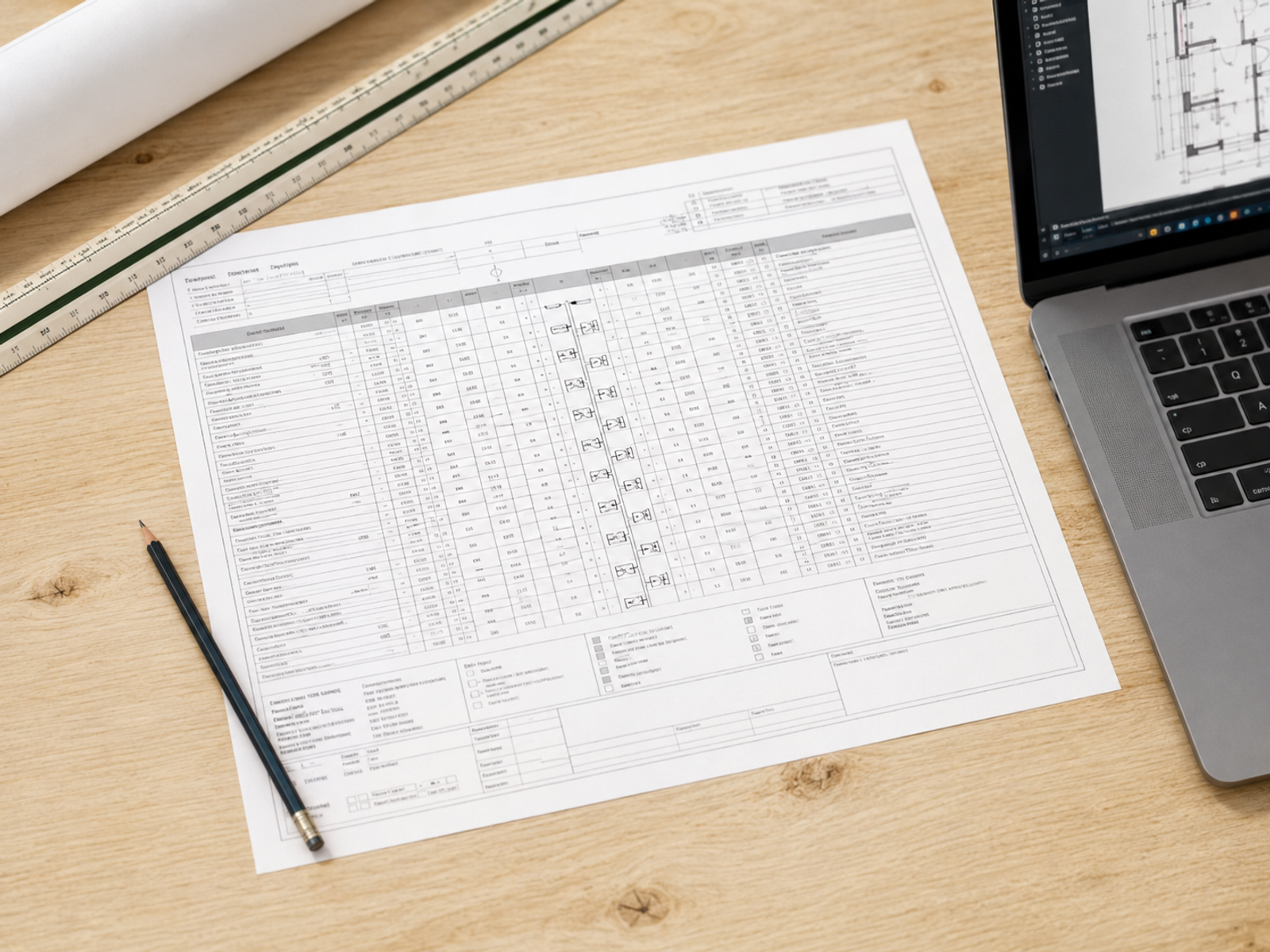

Panel Schedule Drafting Standards: What Actually Makes One Build-Ready
Most panel schedules pass a visual check and still fail in the field. Here's what actually makes one build-ready.

Load Flow Studies for Industrial Facilities: Why Nameplate kVA Isn't Demand
Nameplate kVA tells you almost nothing about actual demand. Here's why a load flow study built on real data changes the answer.

Short-Circuit Studies: What the Per-Unit Method Is Actually Calculating
The per-unit method isn't a shortcut, it's the actual math behind every short-circuit study. Understanding what it's calculating changes how you read the results.